Folk artsNingxia
Hua'er Mountain Songs
The hill-country rock of the northwest: launch a hua'er across the valley and the mountains turn into a sounding board.
The hill-country rock of the northwest: launch a hua'er across the valley and the mountains turn into a sounding board.
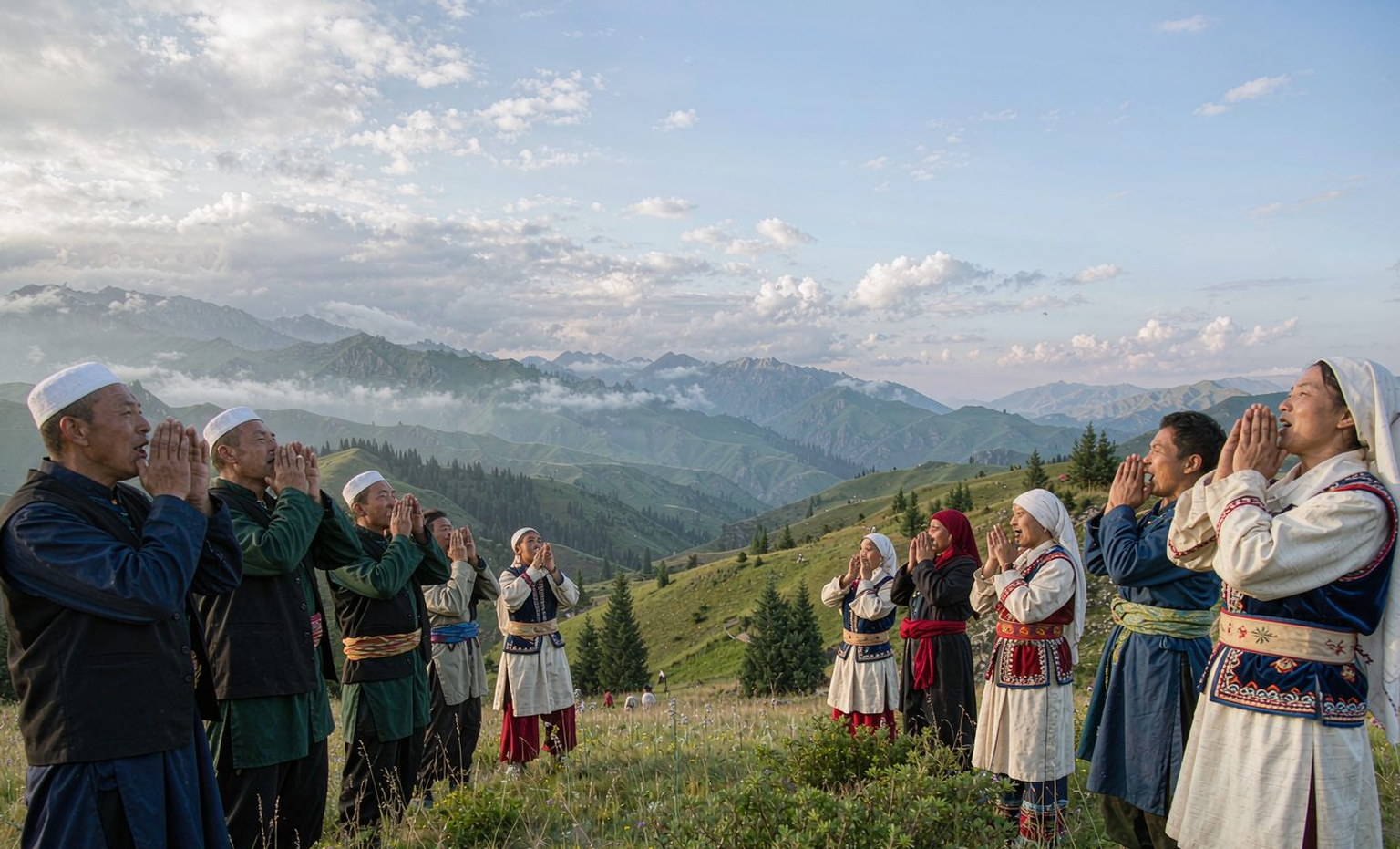
On the loess plateau a high voice breaks into the open and rolls back in three echoes off the ridges. A muleteer lets loose, kneading longing, hardship and joy into the tune. Down the slope a girl answers, red-faced — across a gully, two voices turn love into a reply.
Whatever you want to say, sing it: the hottest confessions of the northwest are all handed to hua'er.
Traditions, echoed by a new generation
Lines improvised on the spot, no rehearsal: a northwestern freestyle. Push the earthiness far enough and it becomes art.
A folk song on the UNESCO Representative List that you can still start up in the middle of a field
Improvised answering songs are a live duel of wit, and the wordplay gives any rap battle a run for its money
At the hua'er fairs below the Liupan Mountains, ten thousand people trade verses — a golden week for the ears
History · Customs · Cultural meaning
 Hua'er Mountain Songs · Historical Origins
One continuous line · back to the source
Hua'er is a body of folk song from Gansu, Qinghai, Ningxia and the wider northwest, named for the habit of calling a young woman a hua'er — a flower — in the lyrics. It is sung across ethnic lines by Han, Hui, Tu, Salar, Dongxiang, Bonan and Tibetan communities, and is often called the soul of the northwest.
Hua'er falls into two great systems, Hehuang hua'er and Taomin hua'er, with the Liupan Mountains of Ningxia one of its important schools. In 2006 hua'er — the Hui mountain song of Ningxia — was inscribed on the first national list of intangible cultural heritage (No. Ⅱ-20); in 2009 it was added to the UNESCO Representative List of the Intangible Cultural Heritage of Humanity.
Hua'er Mountain Songs · Customs and Practice
Seasonal ritual · everyday life
Hua'er is mostly improvised out of doors, in the hills and the fields, which is why it is also called man hua'er — letting the song spread. There are more than a hundred melodic types, qu ling, and the texts run mostly to four or six lines, built on allusion and parallel imagery: the first line paints the scene, the second releases the feeling. Subjects range from love and labour to current affairs and historical legend.
The hua'er fairs are enormous occasions. On set days of the lunar calendar, singers from villages ten li around gather in the open country and answer each other for a day and a night; the winners become famous well beyond their own valley. It amounts to the northwest's annual folk singing championship.
Hua'er Mountain Songs · Cultural Significance
Where the heart points · carried down the generations
Hua'er holds the record of centuries of cohabitation and shared singing among the ethnic groups of the northwest, and it is a treasury for anyone studying folk poetry, music and social life.
Ningxia now brings hua'er into classrooms and runs the festival calendar, and the Liupan Mountains hua'er fair opens on schedule every year — the high voice on the mountain wind is still looking for listeners.
Related customs
← Scroll sideways for more →
Fact-checked October 2026 · every citation traceable
Primary sources are Chinese-language publications, cited for traceability. Bodies without a standard English name are listed by domain.