FestivalHainan
Junpo Festival
A great festival of northern Hainan, held in memory of Lady Xian: mustered troops on the march, cheek piercing and fire walking, and a noise you feel in the chest.
A great festival of northern Hainan, held in memory of Lady Xian: mustered troops on the march, cheek piercing and fire walking, and a noise you feel in the chest.
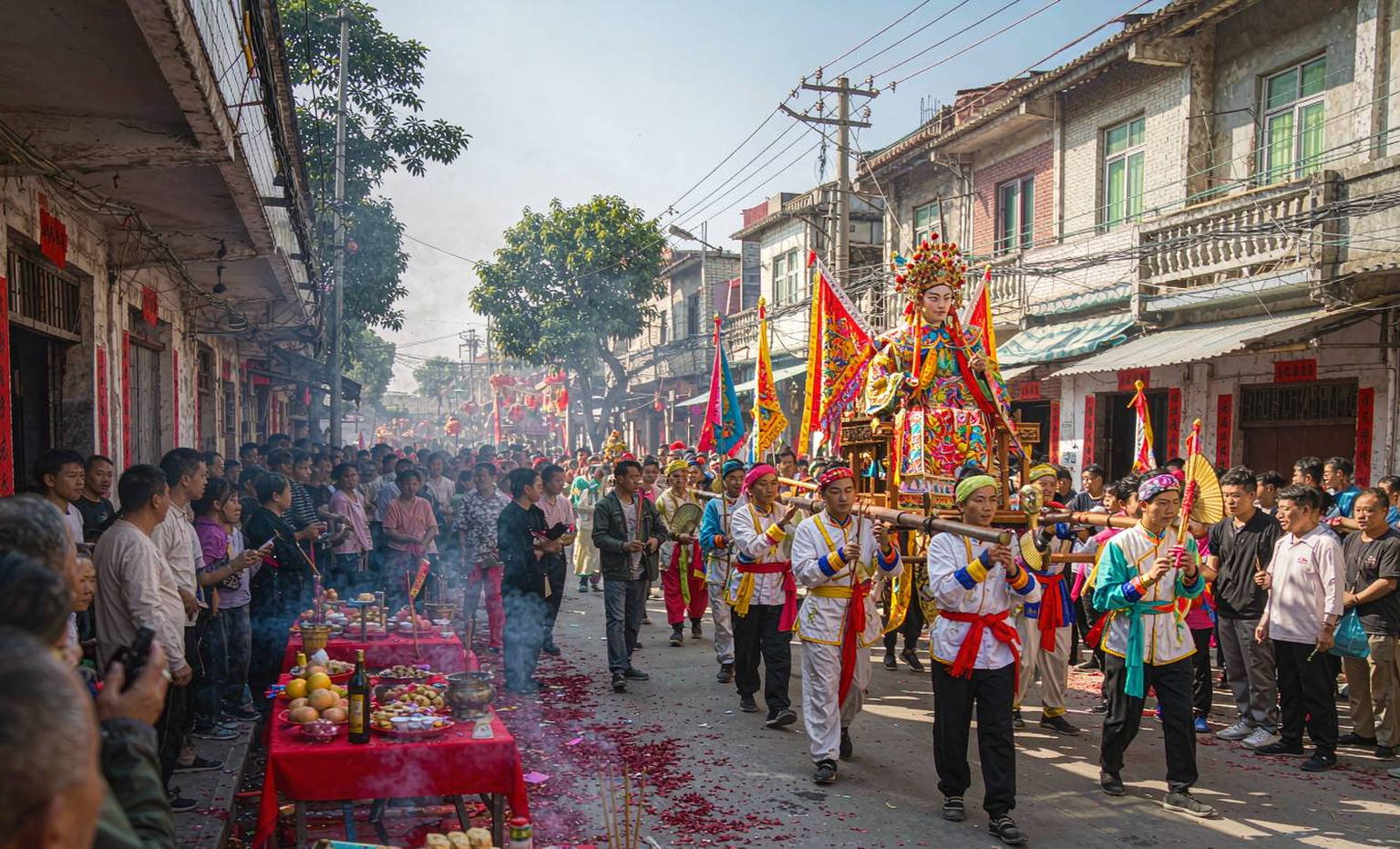
Gongs and drums lead the way, banners stand thick as a forest, and the 'mustered army' files through the villages dressed as the soldiers of old. Some walk barefoot across a bed of hot embers; some pass a long skewer through the cheek without a change of expression. The fire walkers' soles are scorched black, the pierced walk out through the middle of the street, and the column does not stop and the drums do not rest.
One woman general who guarded this coast for a thousand years: Junpo is Hainan's gratitude, still at full heat.
Traditions, echoed by a new generation
Cheek piercing, fire walking and the mustered-army procession: every element of Junpo lands with visual force.
Cheek piercing and fire walking are extraordinary to see at first hand — a yearly feast for photographers
Meet Lady Xian, a woman general out of legend, more real and more moving than any costume drama
Each village keeps a different date, so one trip can take in several of these village spectacles in a row
History · Customs · Cultural meaning
 Junpo Festival · Origins
One line of descent · tracing the root
Junpo is the most influential folk festival of northeastern Hainan, said to commemorate Lady Xian, the woman leader of Lingnan from the Southern Dynasties to the early Sui. She lived through the Liang, Chen and Sui dynasties, worked to hold the country together and to pacify the Baiyue peoples, and was called by Zhou Enlai 'the foremost woman hero of China'; in Hainan she is honoured as 'the Holy Mother of Lingnan'.
The date of Junpo differs from place to place, fixed to the day Lady Xian's troops were said to have arrived — 'sending out the junpo'. Around Haikou it usually falls from the sixth to the twelfth of the second lunar month; in Ding'an it runs from early in the first month to the end of the third; in Chengmai it stretches from the first month to the end of the fifth.
Junpo Festival · Customs
Seasonal rites · the life of people
The core rite is zhuangjun, 'mustering the troops': villagers dressed as soldiers form up in the old order and process, with banners, gongs, drums and the eight-tone ensemble complete, restaging the dignity of Lady Xian's march. Some villages keep the feats of chuanzhang, a long steel skewer run through the cheek, and crossing the fire, walking barefoot over embers — tests of nerve and of sincerity.
Every household sets out a banquet for guests, on the principle that anyone who comes is a guest, so that even a stranger is received with warmth; opera troupes play for days, and the excitement rivals the New Year.
Junpo Festival · Cultural meaning
What the heart turns to · handed down through generations
Junpo is a living fossil of Hainan's migration history and of the blending of its peoples. It holds the island's reverence for Lady Xian's principle of 'one good heart, and nothing else', and sustains the networks of obligation that bind clans and villages.
In 2014 the cult of Lady Xian, of which Junpo is the festival, was inscribed as an extension of the 'folk belief and custom' category on the fourth national list of representative intangible cultural heritage items, item Ⅹ-85, and has become the signature of cultural tourism in northern Hainan.
Related customs
← Scroll sideways for more →
Fact-checked October 2026 · every citation traceable
Primary sources are Chinese-language publications, cited for traceability. Bodies without a standard English name are listed by domain.