Folk artsXinjiang
The Twelve Muqam
Twelve great suites that take more than twenty hours to sing through — the Uyghur encyclopaedia of music.
Twelve great suites that take more than twenty hours to sing through — the Uyghur encyclopaedia of music.
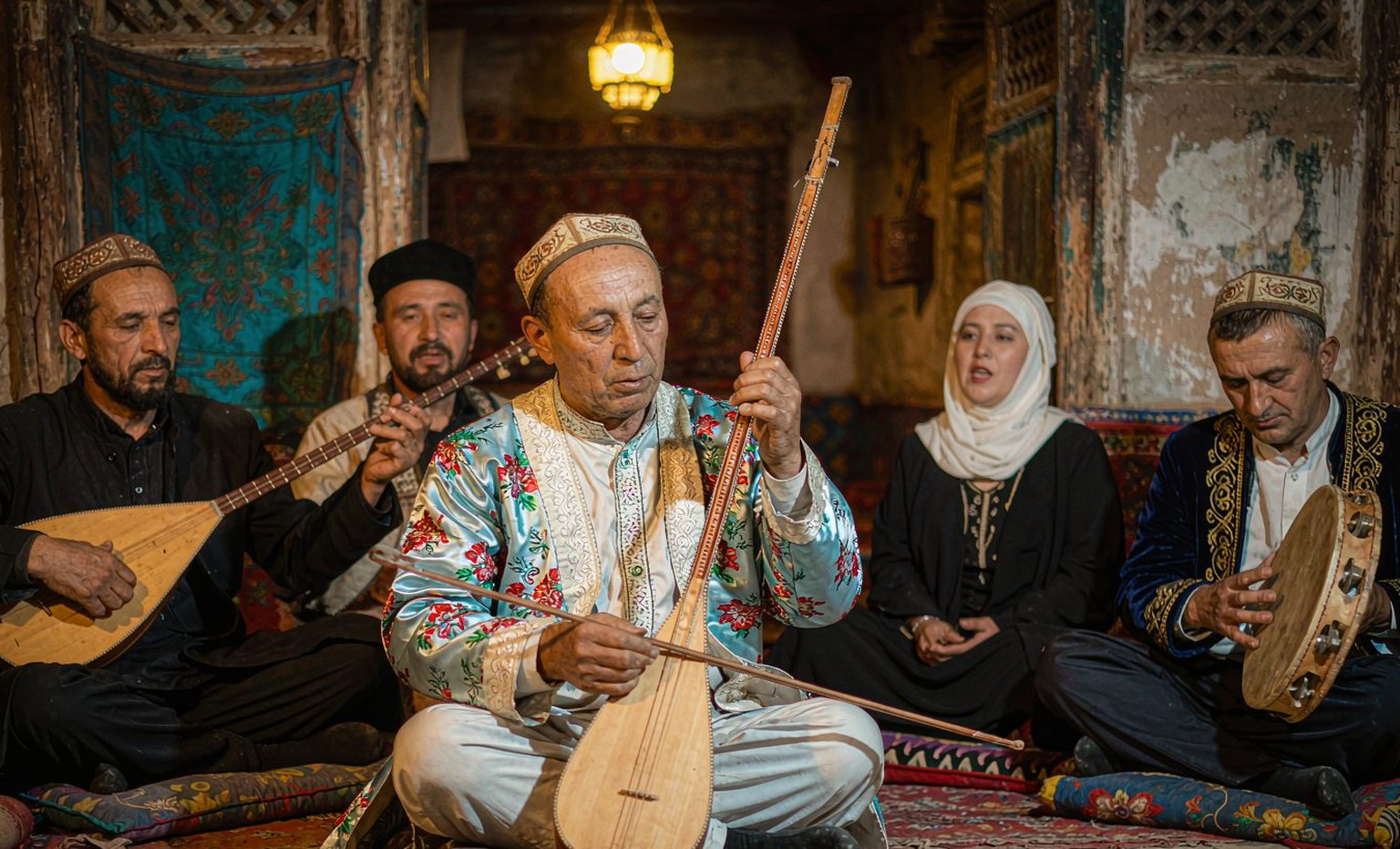
The satar keens and the singer takes up a muqam wide as open country. The free prelude stretches out, the sung sections rise, and the dance steps break the moonlight. Hours pass in a single stretch, from moonrise to moonset — a melody running in Uyghur blood, with a thousand years of grief and joy inside the mode.
One muqam is one epic — where the music starts, a thousand years of the Silk Road wake in the ear.
Traditions, echoed by a new generation
The ancient world's music marathon: twelve suites sung round the clock without repeating a piece — a scale that dwarfs any concept album.
On UNESCO's Representative List — the summation of Uyghur music
Song, dance and instrumental music in one; a single performance is a Silk Road tone poem
Rawap, satar and dap sounding together — the timbres of the Western Regions in one sitting
History · Customs · Cultural meaning
 The Twelve Muqam · Historical Origins
One continuous line · back to the source
The Twelve Muqam is the great classical suite cycle of the Uyghur. Each muqam comprises three large parts — the qong naqsh, the dastan and the meshrep — and holds more than 170 songs, dances and instrumental pieces; a complete performance runs over twenty hours.
Its roots reach back to the 'Mohe Dulü' of the Western Regions and the Kucha musical and dance tradition. In the sixteenth century Amannisahan, consort of the khan of Yarkand, presided over a systematic collation; later generations of editors standardised the material until it settled into twelve suites. In 2005 the Uyghur Muqam of Xinjiang was inscribed on UNESCO's Representative List of the Intangible Cultural Heritage of Humanity.
The Twelve Muqam · Customs and Practice
Seasonal rites · everyday life
Performances are accompanied by satar, tanbur, rawap, dap and other instruments. The texts range across philosophical verse, love songs and long narrative ballads, much of it classical Chagatai poetry in which literary polish and reflection carry equal weight.
The format is flexible: folk artists may sing unaccompanied in a teahouse courtyard, or a company of several dozen may take the stage, singers, dancers and players performing together — fervent, expansive, on a large scale.
The Twelve Muqam · Cultural Significance
What the heart turns toward · handed down through generations
The Twelve Muqam carries Uyghur philosophical outlook, social life and the memory of civilisations meeting along the Silk Road. It is the summation of Uyghur musical culture and a living witness to the musical exchange of the many peoples of the Silk Road.
Xinjiang maintains muqam heritage centres and performing companies, and the 'root' singing of senior artists has been systematically recorded and archived — a thousand-year cycle still passing through the mouths of a new generation of singers.
Related customs
← Scroll sideways for more →
Fact-checked October 2026 · every citation traceable
Primary sources are Chinese-language publications, cited for traceability. Bodies without a standard English name are listed by domain.