Folk artsYangliuqing (Tianjin), Taohuawu (Suzhou), Weifang (Shandong) and beyond
Woodblock New Year Prints
Folk pictures pasted up at New Year, carrying wishes for good fortune and driving off ill luck.
Folk pictures pasted up at New Year, carrying wishes for good fortune and driving off ill luck.
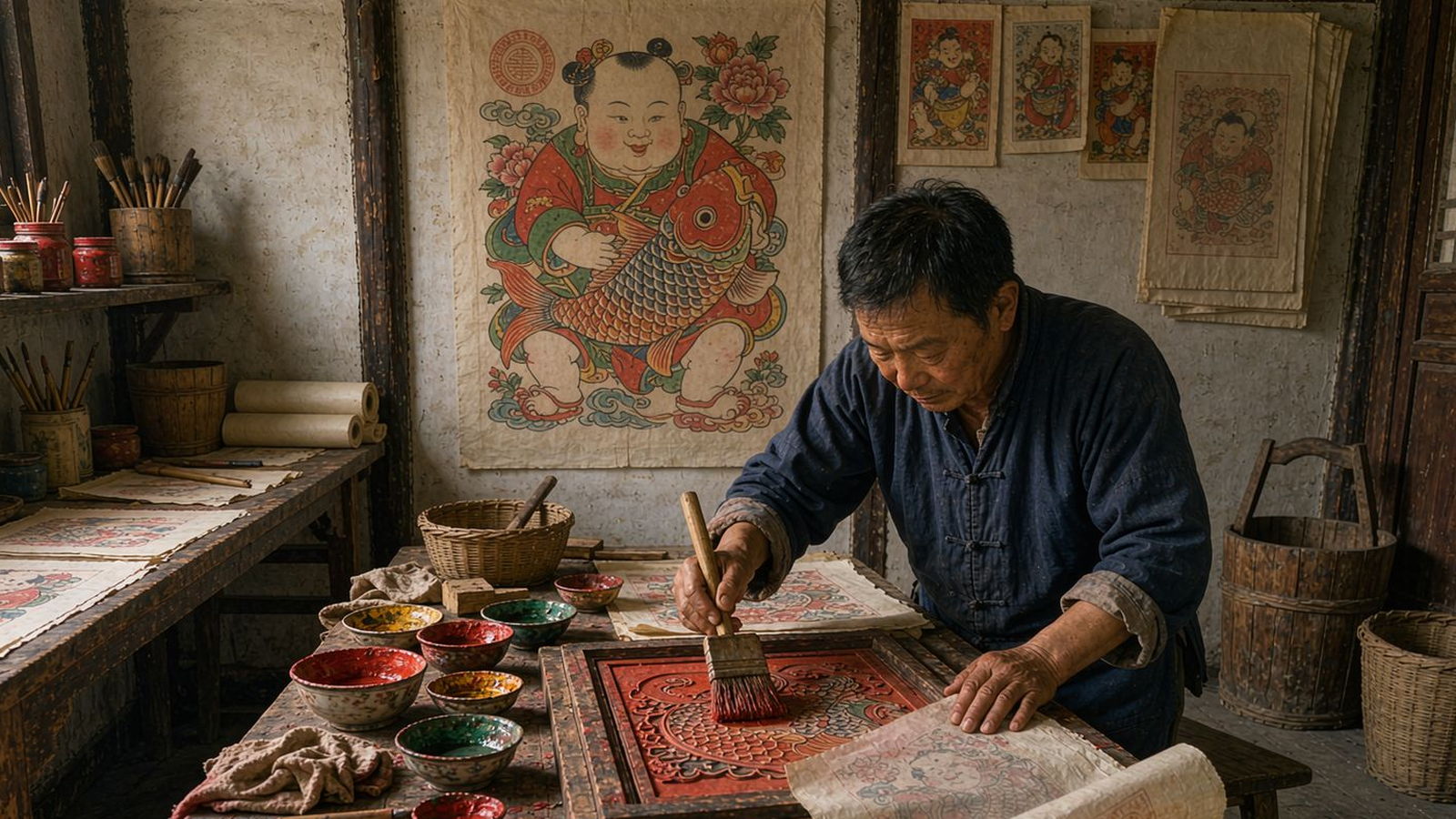
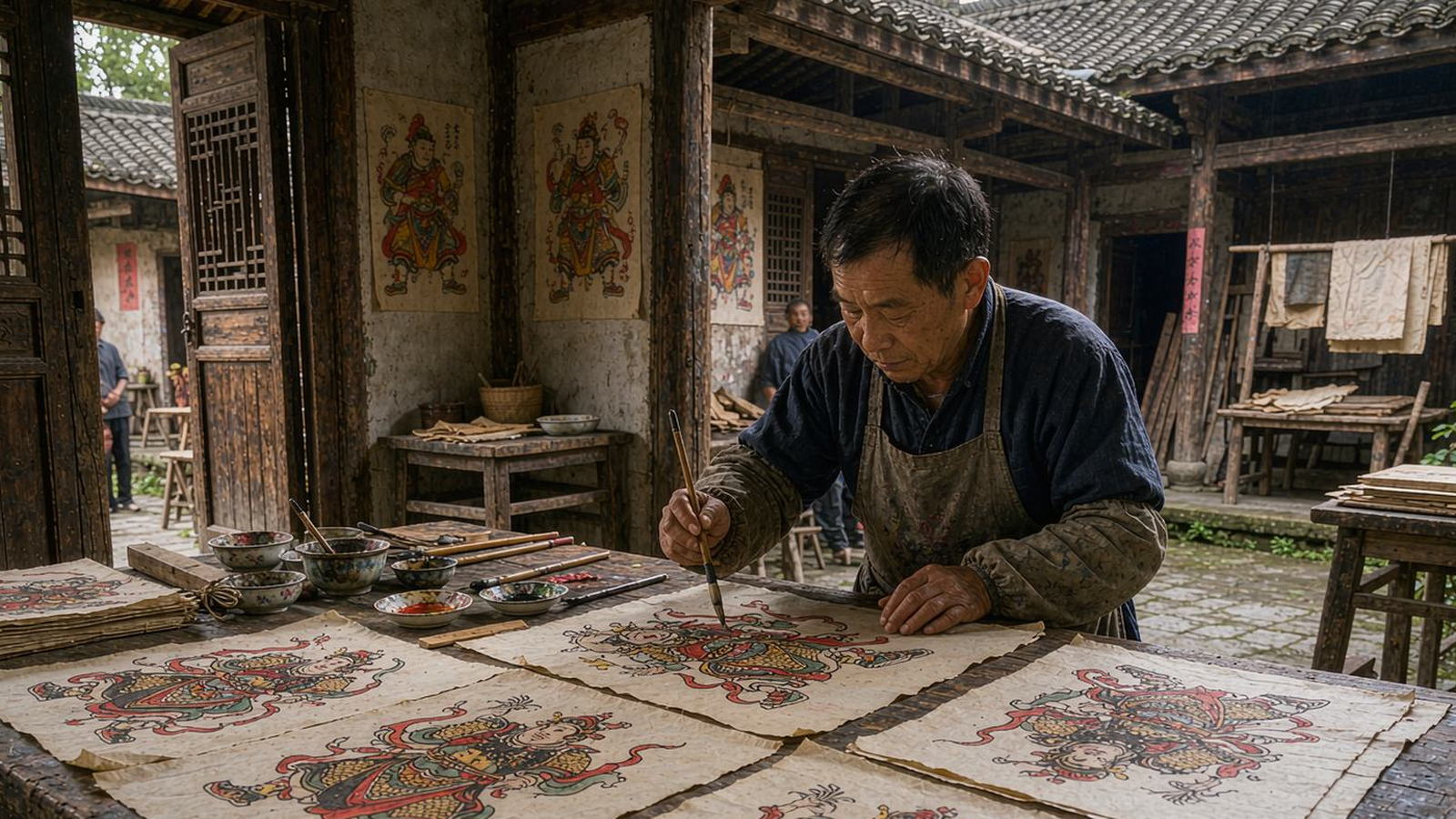
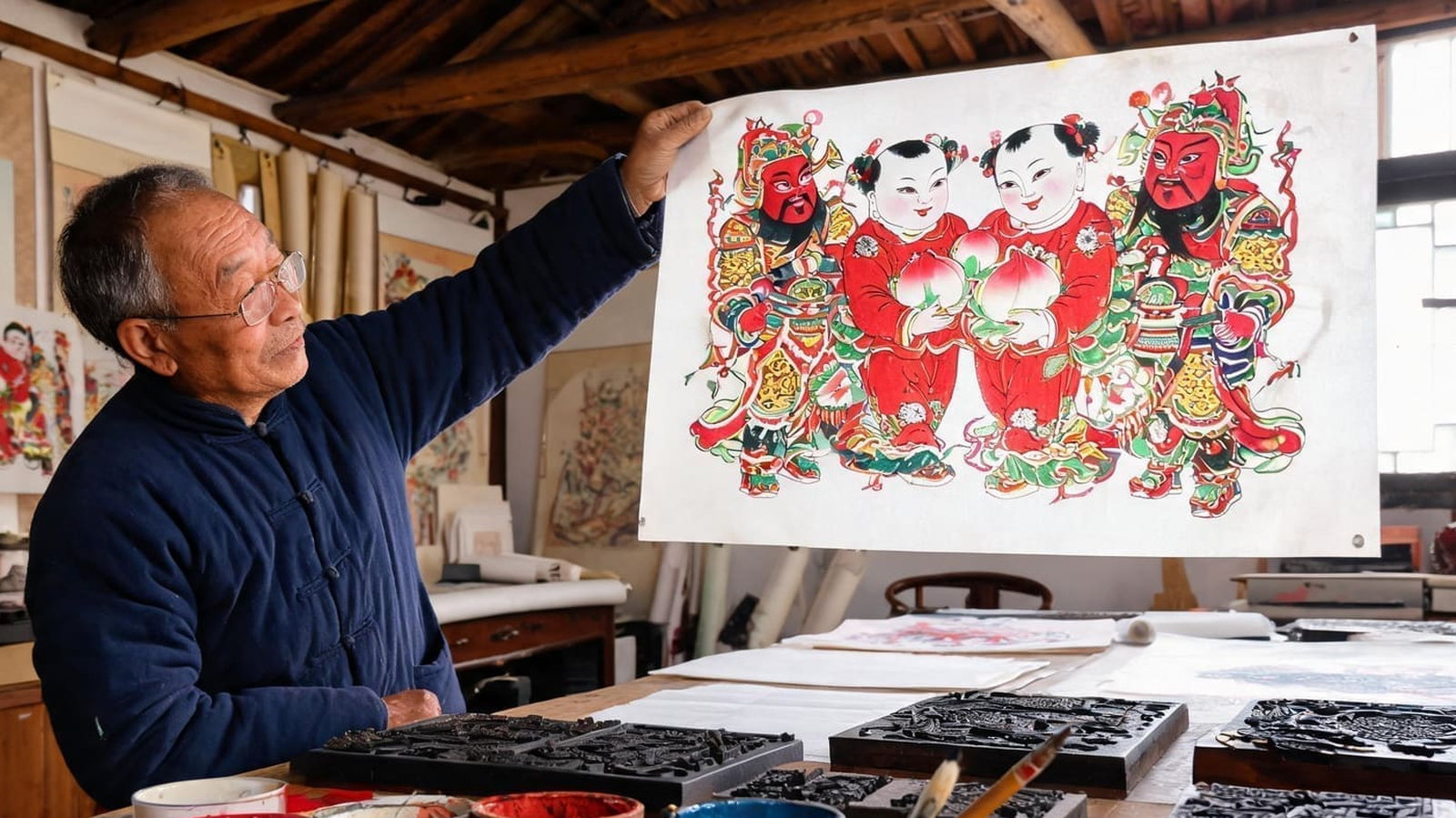
As the year turns, the print shops of Yangliuqing are thick with colour that will not thin. A chubby baby hugs a great red carp; a door god glares, whip in hand; the line block is printed and then the colourist fills it in by hand, a stroke of peach pink, a stroke of grass green. Every household pastes the pictures on door leaves and walls, and an earthen cottage suddenly glows. That is how the New Year is invited in — one sheet at a time.
What the New Year print shows is what ordinary people wish for — children, surplus, safety, blessing: plain, and full of life.
Traditions, echoed by a new generation
The New Year print is the Chinese poster for the season — red, loud, busy — and the year only truly arrives when one goes up on the door.
A chubby baby gripping a carp, a door god with staring eyes: the most artless kind of happiness, in the most endearing form
Saturated reds, yellows and greens, frankly vulgar and joyfully bright — Chinese optimism with its sleeves rolled up
Printing a sheet yourself — the smell of ink and the feel of the season are things a digital red envelope can never give
History · Customs · Cultural meaning
 Woodblock New Year Prints · Historical Origins
One continuous line · back to the source
The woodblock New Year print grew out of the ancient door-god picture, traceable as far back as the Han. With the spread of block printing in the Song, printed New Year pictures appeared — then called 'paper pictures', printed in black line and usually coloured by hand. Production peaked in the Ming and Qing, when the celebrated centres took shape: Yangliuqing in Tianjin, Taohuawu in Suzhou, Yangjiabu in Weifang, Shandong, and Mianzhu in Sichuan.
Woodblock New Year Prints · Customs and Practice
Seasonal rites · everyday life
The subjects are many: door gods (Qin Qiong and Yuchi Gong), the God of Wealth, the Kitchen God, the three star gods of Fortune, Prosperity and Longevity, 'abundance year after year' (lotus and fish, a pun on the words), five grains in abundance, scenes from opera. Yangliuqing is known for work 'half printed, half painted', with restrained colour; Taohuawu for fine colour-registered blocks; Yangjiabu for a plain, robust manner. In the twelfth lunar month every household buys new prints and pastes them up, seeing the old year out and the new one in.
 Woodblock New Year Prints · Cultural Significance
What the heart turns toward · handed down through generations
The woodblock New Year print is one of the most representative folk arts of agrarian China. In direct visual images it carries ordinary people's longing for and prayers for a good life, and it is important material for the study of folk belief and social life. The traditions of Yangliuqing, Taohuawu, Yangjiabu and Mianzhu were all entered on the first national list of intangible cultural heritage in 2006.
To admire and to use · Tradition in everyday life
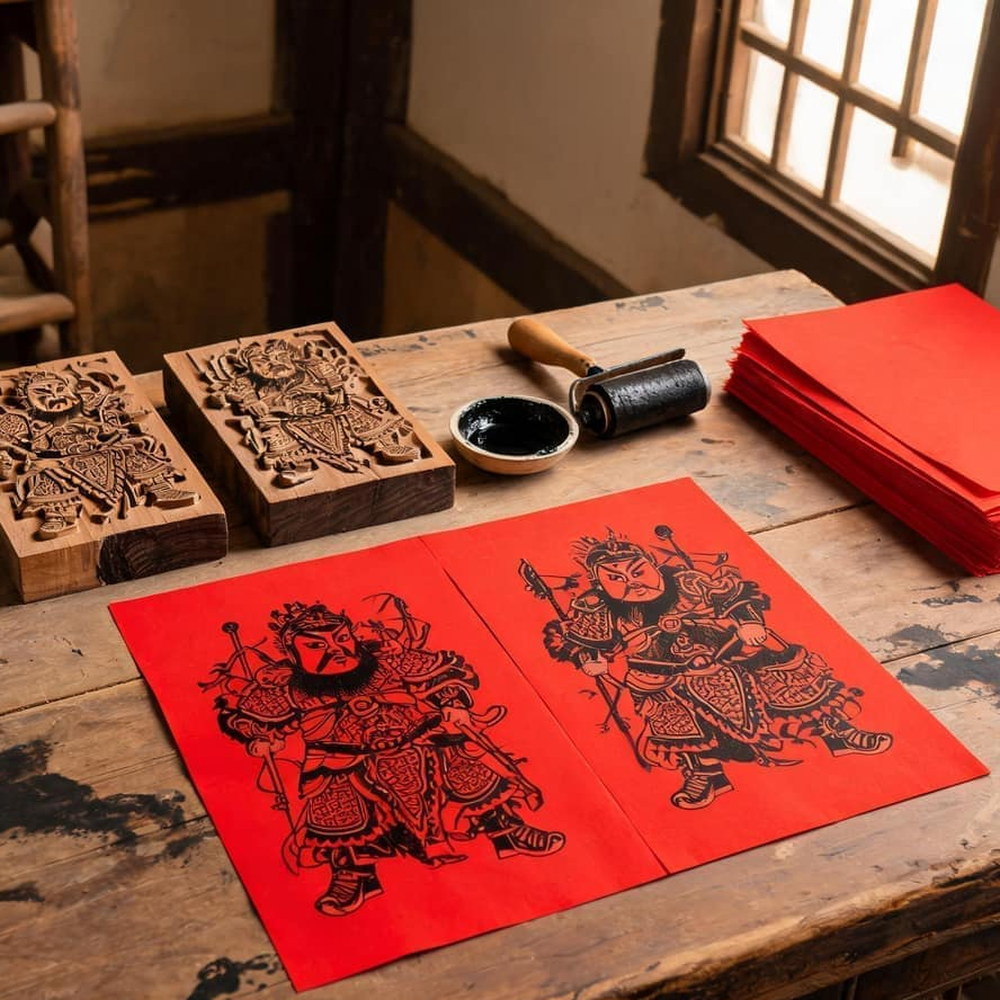 Experience
Lay the paper, roll the ink, rub the block — make your own door god
Case: Lay the paper, roll the ink, rub the block — make your own door god
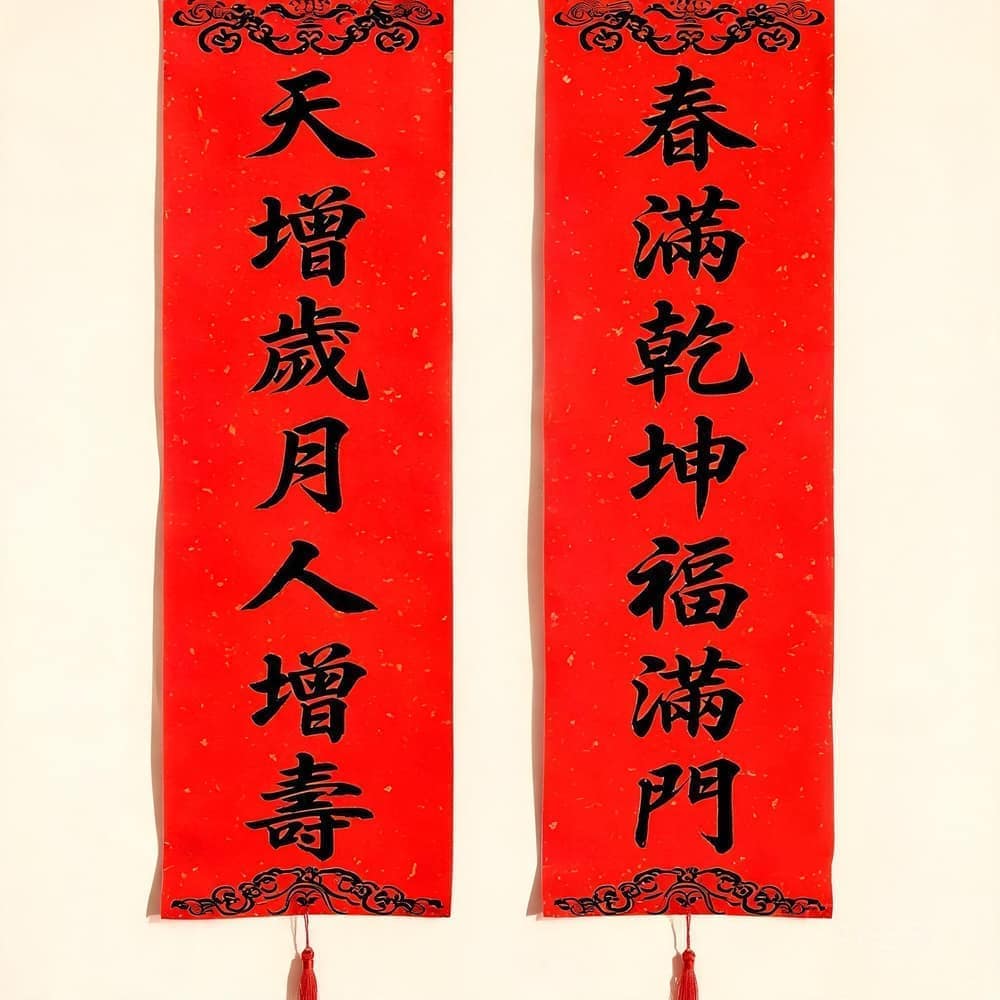 Craft
In the styles of Yangliuqing, Taohuawu and Zhuxianzhen — the season in a packet
Case: In the styles of Yangliuqing, Taohuawu and Zhuxianzhen — the season in a packet
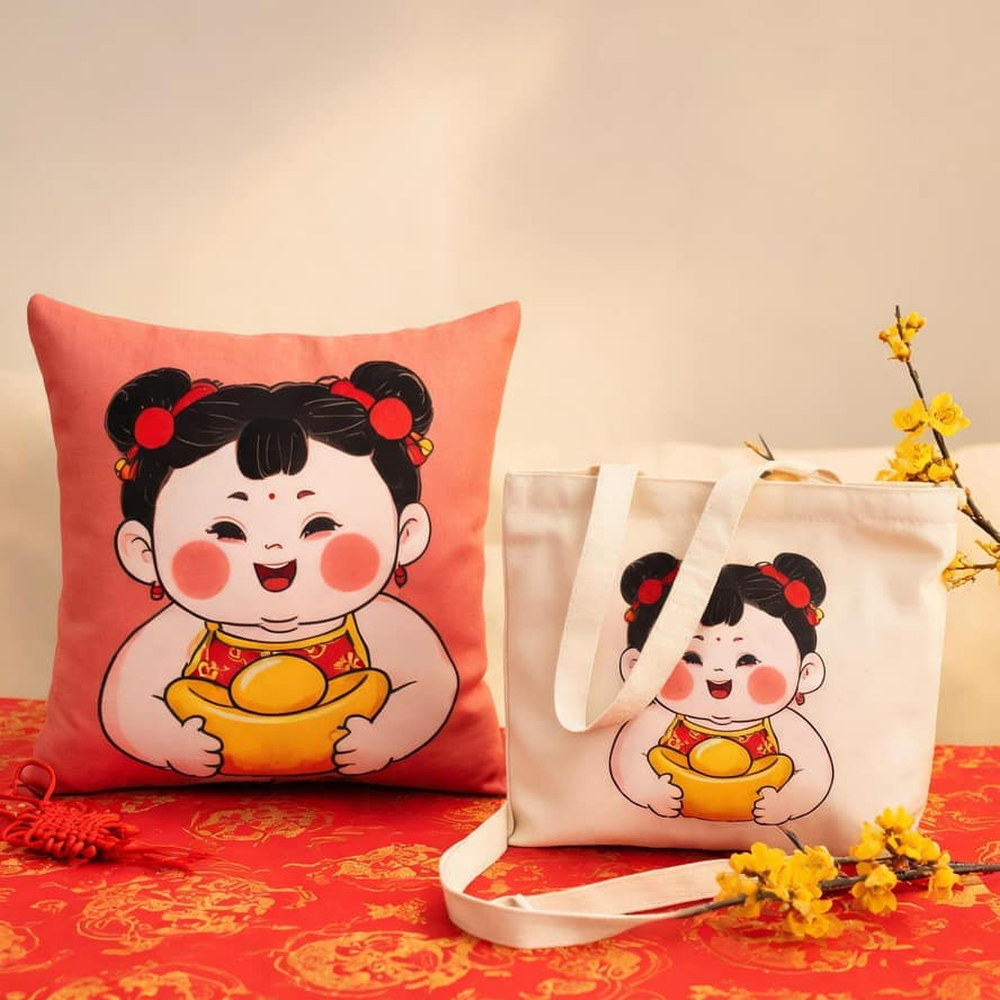 Home
The chubby baby and carp, unbearably cute — carry the luck with you
Case: The chubby baby and carp, unbearably cute — carry the luck with you
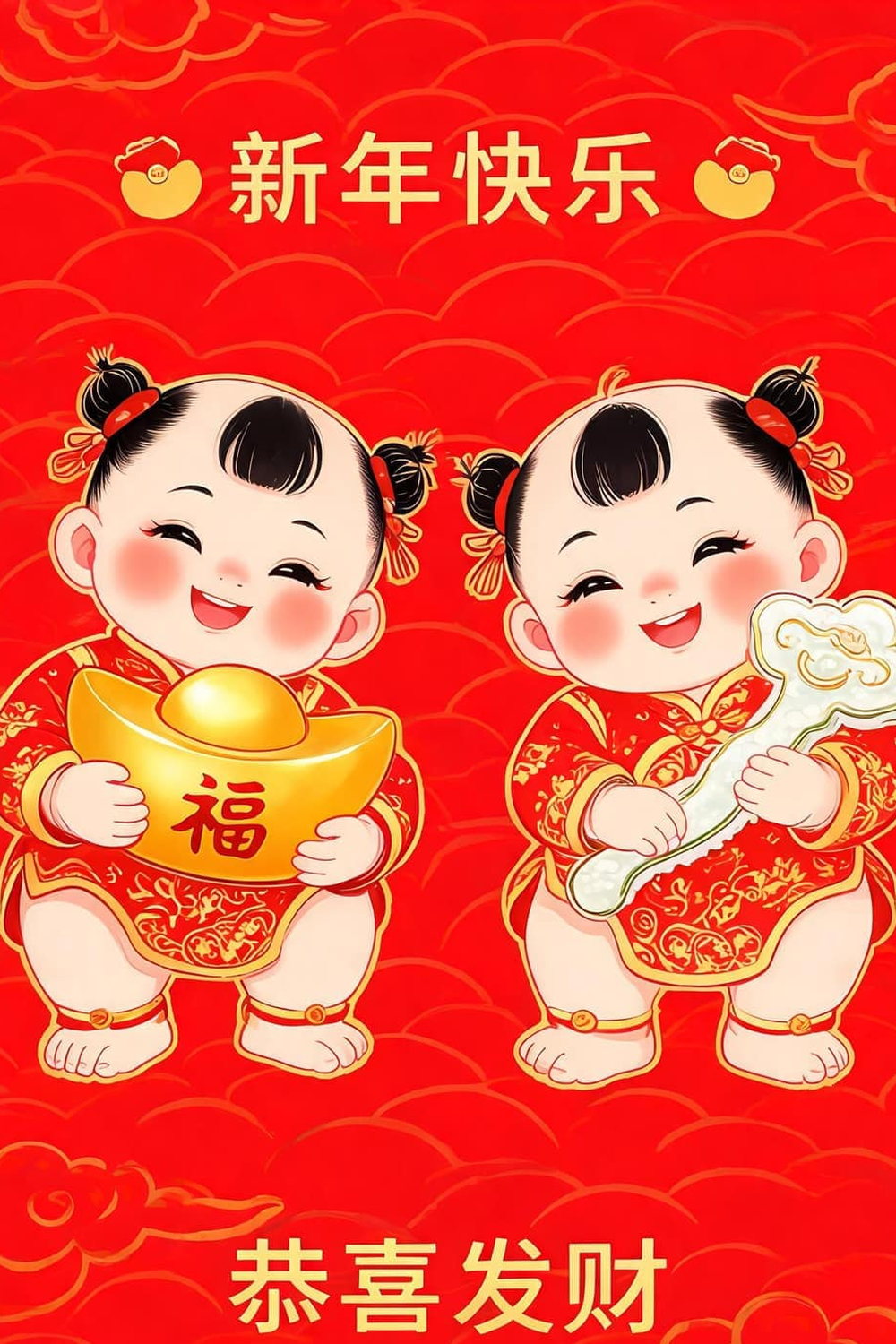 Digital
Even a WeChat envelope can carry a cultural joke and a bit of design
Case: Even a WeChat envelope can carry a cultural joke and a bit of design
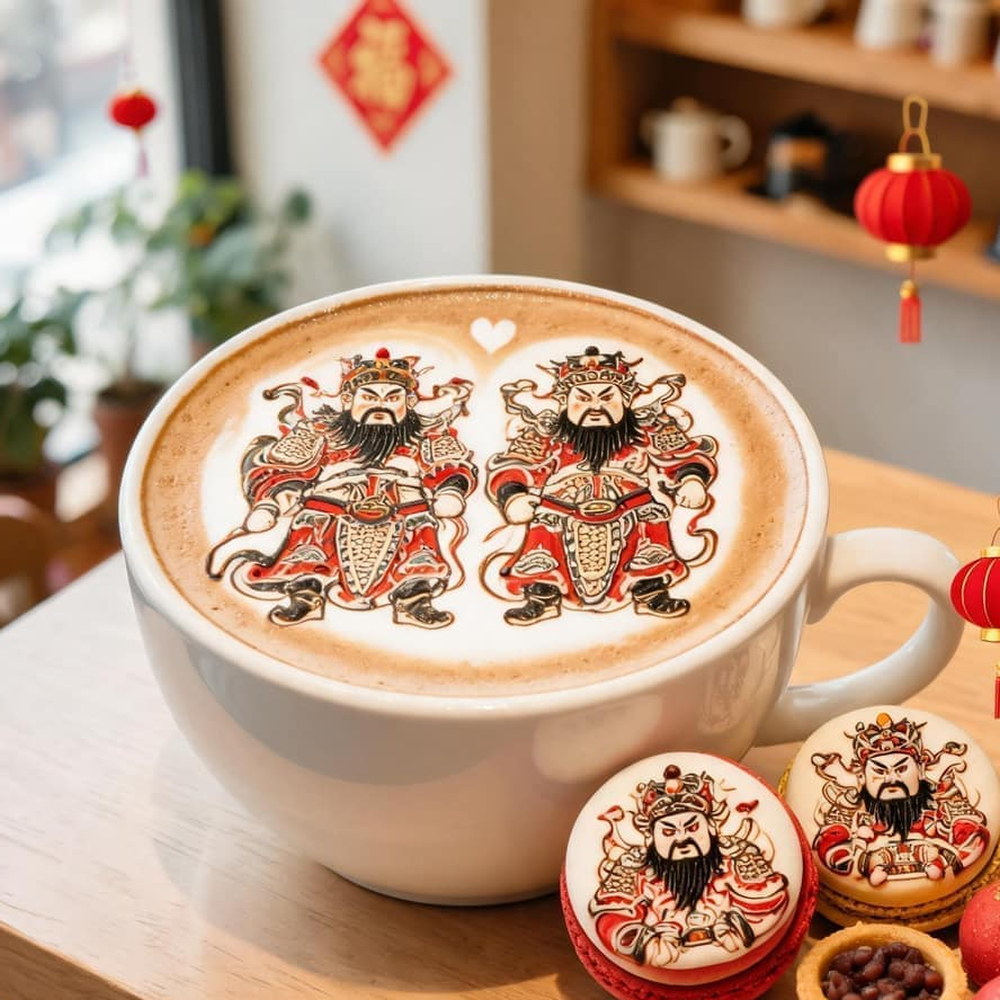 Food
Heritage imagery made young again — good to eat, good to look at, good to photograph
Case: Heritage imagery made young again — good to eat, good to look at, good to photograph
← Scroll sideways for more →
Links lead to third-party marketplaces. This site has no promotional relationship with them.
Travel proposals · Meet the custom in its real setting
← Scroll sideways for more →
Related customs
← Scroll sideways for more →
Fact-checked October 2026 · every citation traceable
Primary sources are Chinese-language publications, cited for traceability. Bodies without a standard English name are listed by domain.