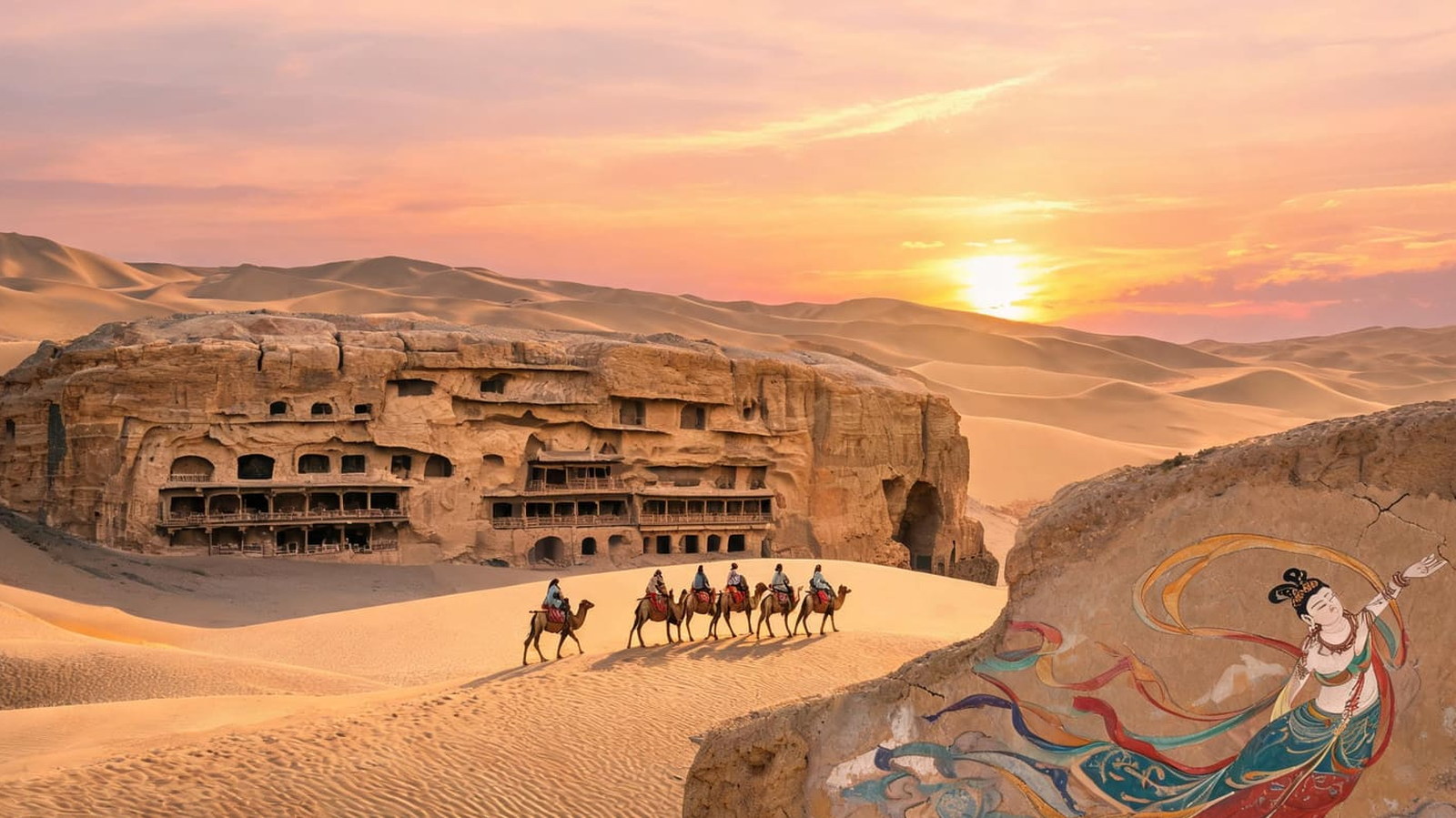
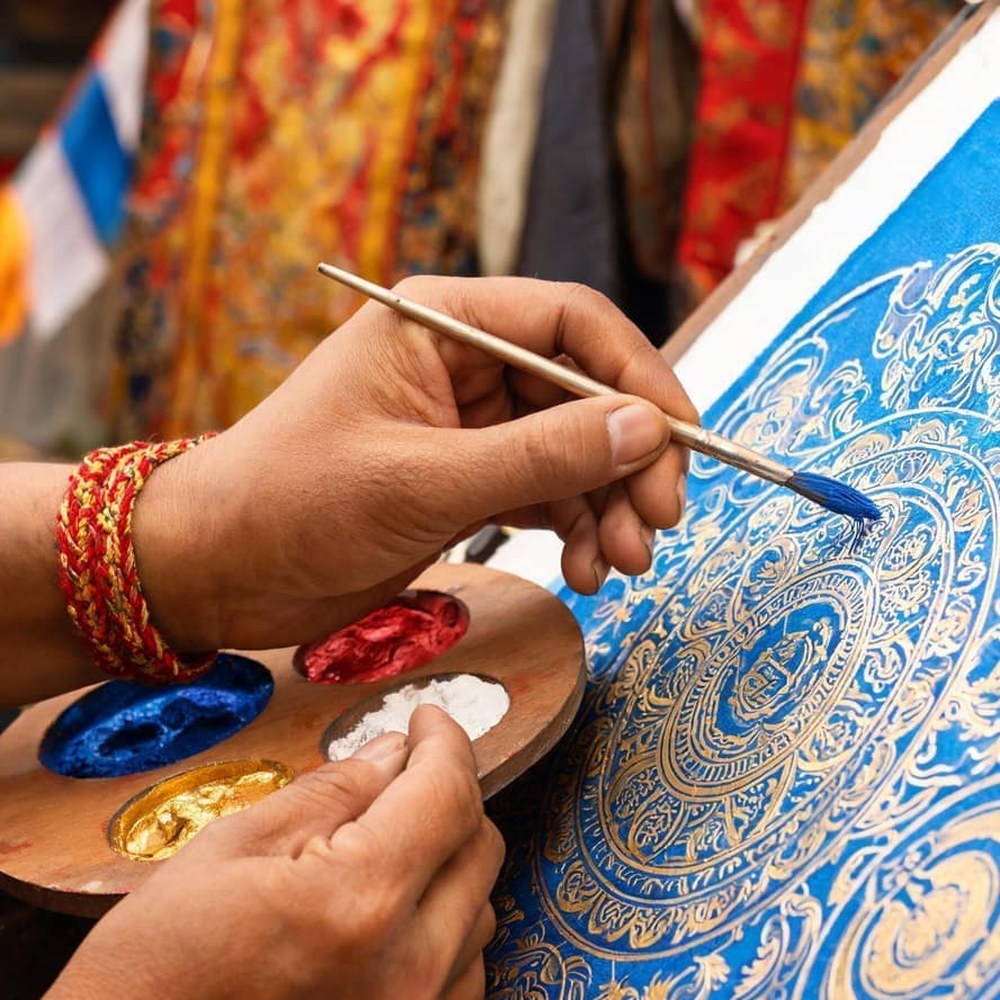
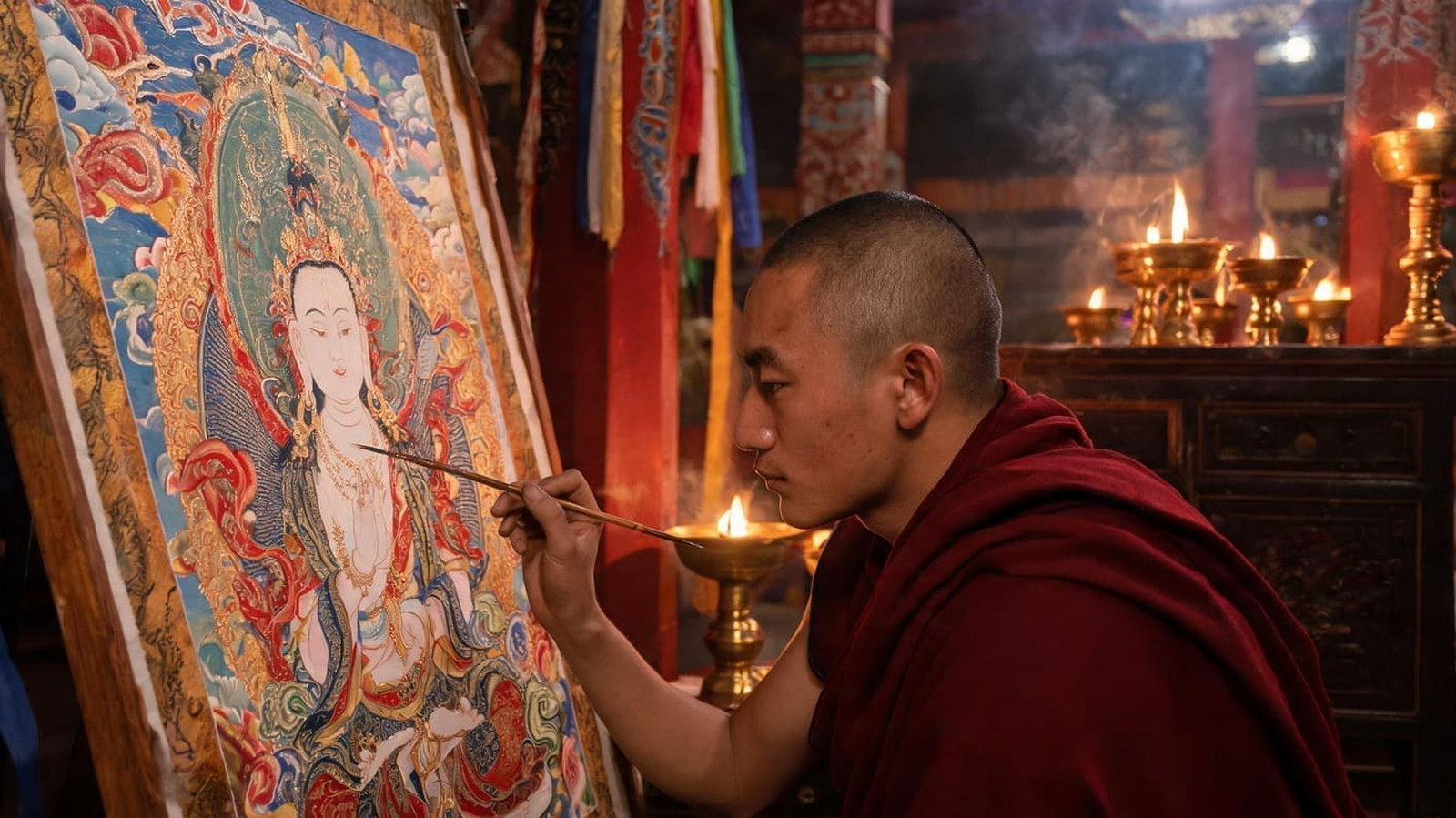
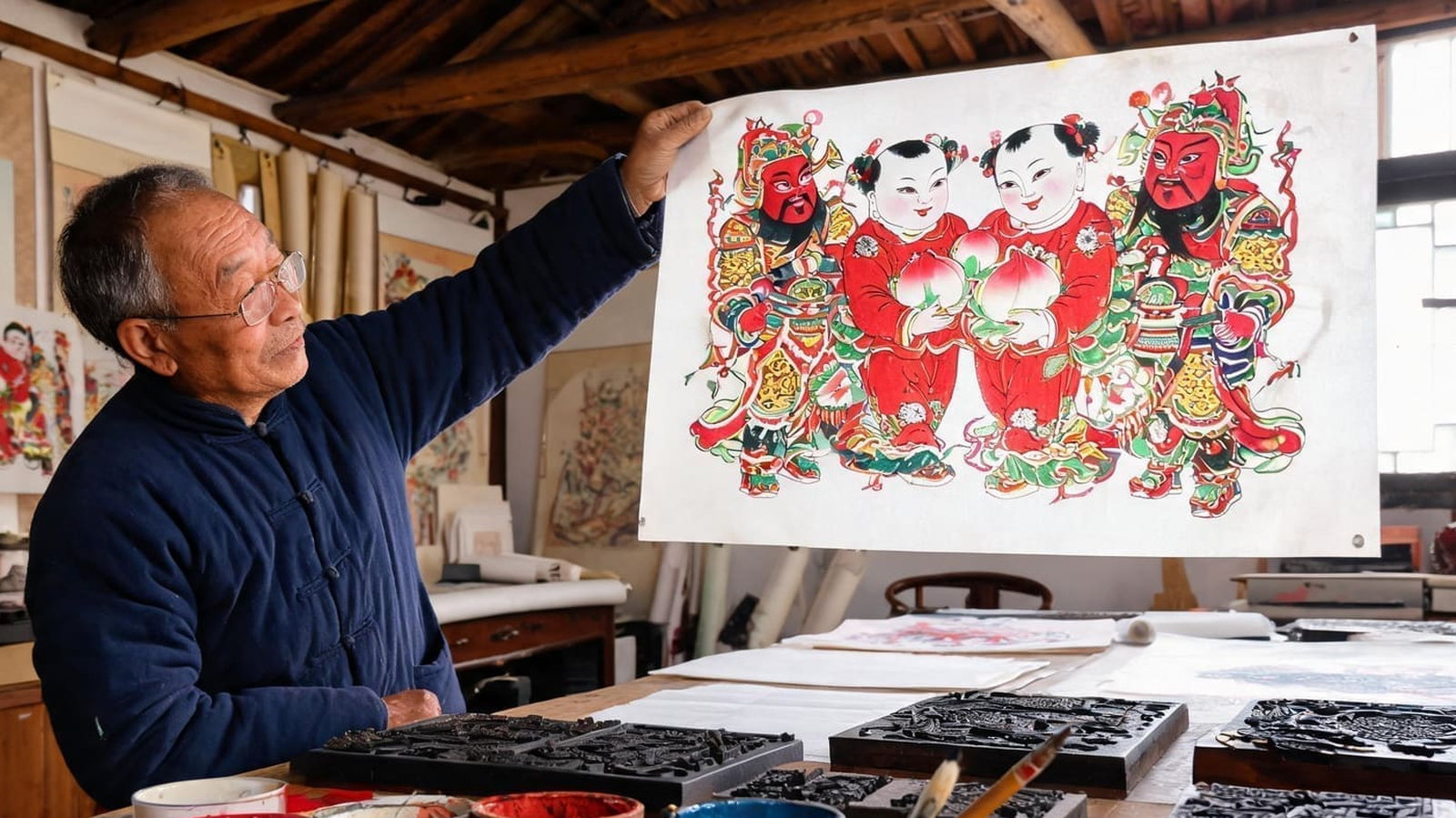
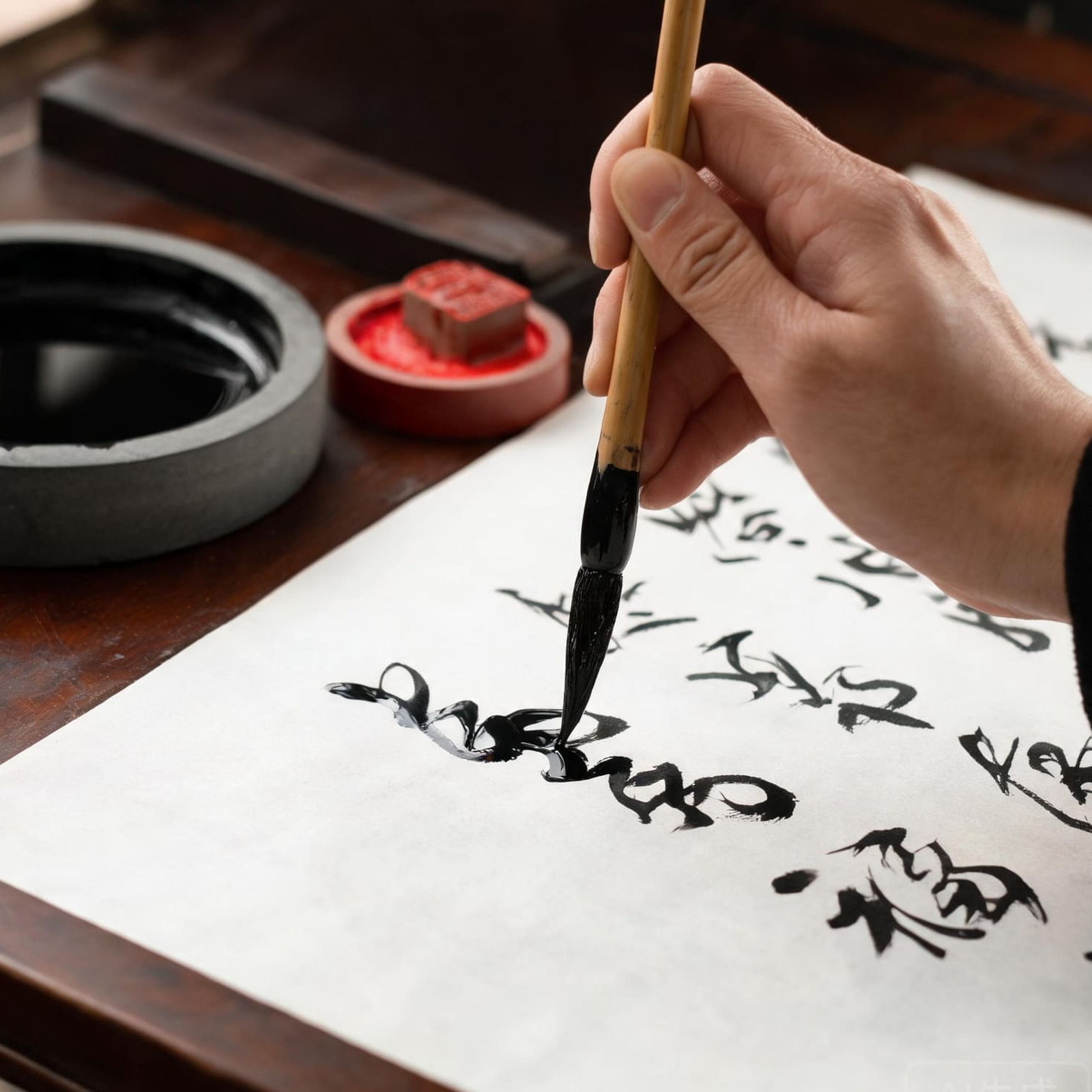
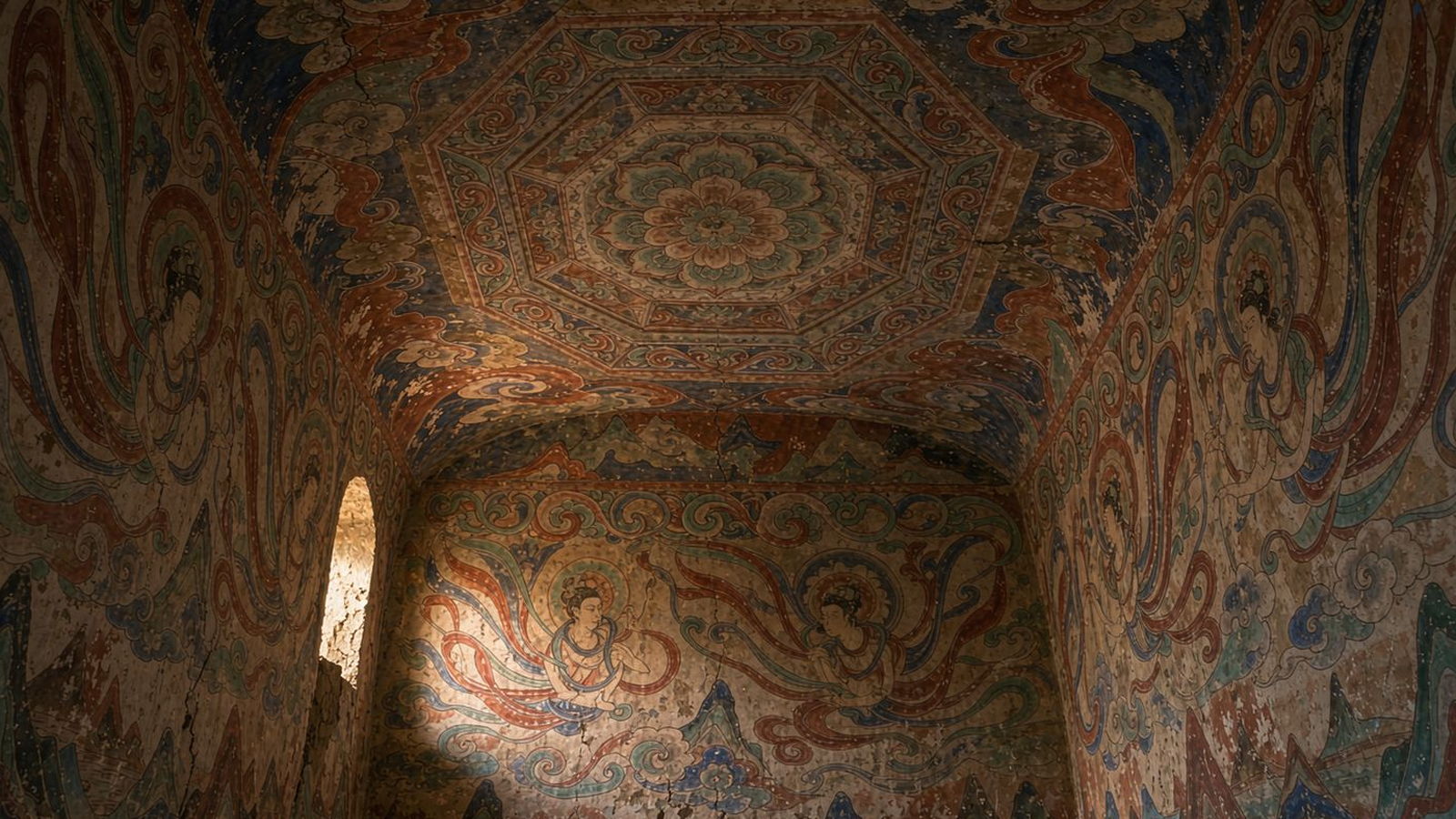
The four walls and the ceiling of every cave are painted over. Earth red, azurite and malachite were laid on in layer after layer, and a thousand years later the doors opened and the colours were still bright.
There is no lighting in the cave and photography is not allowed. By torchlight the walls and ceiling are solid painting: apsaras trailing long ribbons, a lotus at the centre of the coffered ceiling, rows of donors standing along the lower wall. The pigments were ground from stone — cinnabar for red, lapis lazuli for blue, verdigris for green — and a thousand years on, the colour is still on the wall.
Stone ground into pigment, laid on by a painter's brush stroke after stroke; more than sixteen hundred years later the colour is still there.
Traditions, echoed by a new generation
Mogao has 45,000 square metres of mural. The subjects run from Buddhas and sutra illustrations to hunting, farming and weddings: a social archive painted on a wall.
Mineral pigments do not fade: cinnabar, lapis lazuli, verdigris and mica, all of them ground stone
Hunting, ploughing, weaving, dancing, weddings and funerals: history you can look at
Two hundred and ninety caves have been digitally recorded, so the paintings can be studied on a screen
History · Customs · Cultural meaning
Dunhuang Murals · Historical Origins
One continuous line · back to the source
Mogao was first cut in 366 CE, into the cliff at the eastern foot of the Mingsha dunes at Dunhuang. Caves were opened over a thousand years, from the Sixteen Kingdoms to the Yuan, leaving more than seven hundred along some sixteen hundred metres of cliff, of which over four hundred and ninety still hold murals and sculpture.
In 1944 the National Dunhuang Art Research Institute was founded, the first time the caves had full-time staff; it became the Dunhuang Cultural Relics Research Institute in 1950 and was expanded into the Dunhuang Academy in 1984. In 1961 Mogao was designated a national key cultural relic protection site; in 1987 UNESCO inscribed it on the World Heritage List, among China's first World Heritage sites.
Mogao is a Buddhist complex in which architecture, painted sculpture and mural form a single whole: the cave group runs more than sixteen hundred metres and divides into southern and northern zones, with over 45,000 square metres of mural and more than three thousand painted sculptures, the largest of them 35.5 metres tall and the largest single mural about 47 square metres.
Dunhuang Murals · Painting Technique
Ground, plaster, pigment · how a wall was made
The Dunhuang cliff is loose conglomerate and cannot be painted on directly. The painters first spread a mud layer, then a coat of white lime, and only then was the surface smooth enough: the painting sits on this prepared ground.
The pigments were mostly natural minerals: cinnabar and vermilion for red, lapis lazuli for blue, verdigris for green, gypsum and talc for white, mica for a touch of brightness. These minerals are stable and opaque, and although the range of colours was narrow, mixing and layering produced every variation — which is why the colours of Mogao can still be read after a thousand years.
From the late 1970s into the early 1980s, researchers sampled and analysed pigments from more than forty caves, identifying over twenty inorganic mineral pigments and establishing that light is one of the main causes of colour change in wall painting. Today the Dunhuang Academy has digitally recorded the murals of two hundred and ninety caves and built panoramic walk-throughs of more than a hundred and sixty: when the door is shut, these walls exist a second time in data.
Dunhuang Murals · Cultural Significance
Where the heart points · carried down the generations
The murals are the largest holding at Mogao and the hardest to keep: salt efflorescence, flaking paint and detachment of the plaster are conditions somebody has been watching and treating all along. From joint conservation with institutions at home and abroad to scanning the walls sheet by sheet into data, the Academy has really been doing one thing — keeping the colours on the wall, and keeping a copy of them somewhere else as well.
Visitors go in with a guide, one cave opened at a time, and the door is locked behind them. For most of sixteen hundred years these paintings have waited in the dark in exactly this way, for the next door to open.
To admire and to use · Tradition in everyday life
Craft
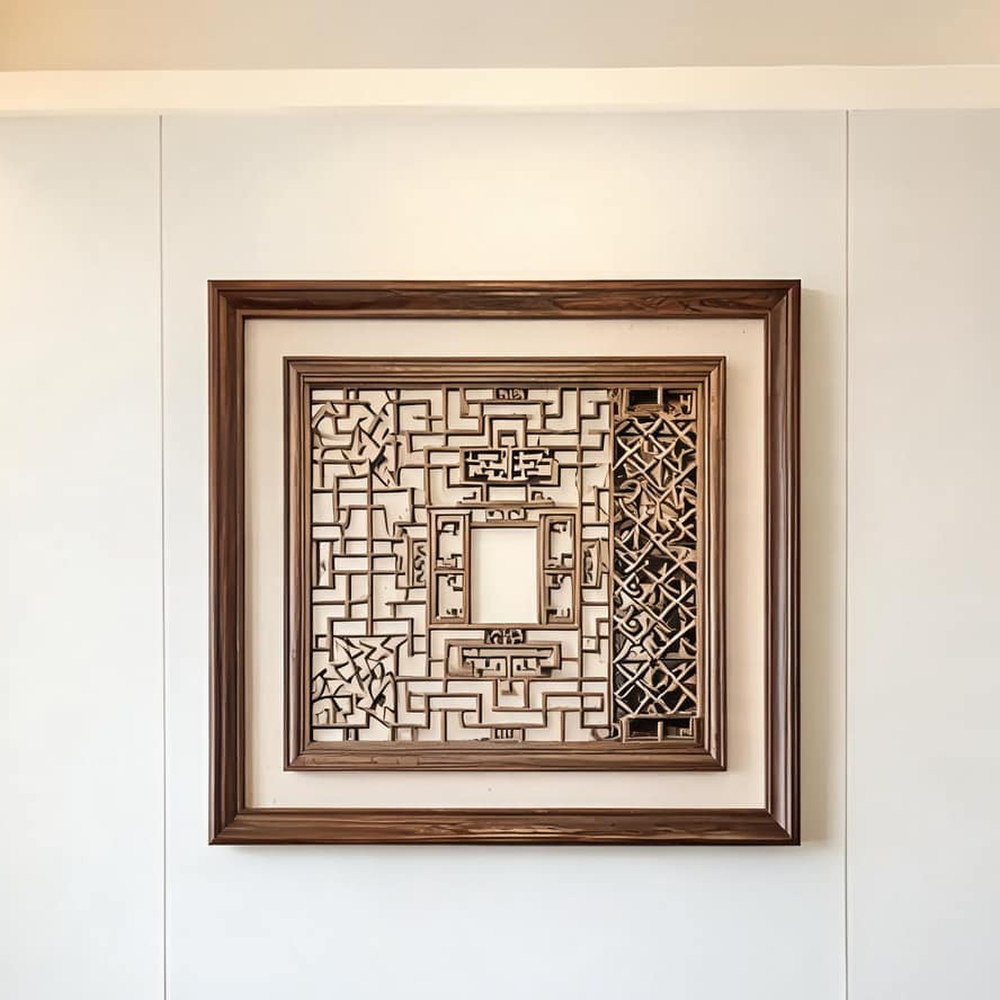
The lotus and scrolling vine of a cave ceiling, brought to a desk
Case: The lotus and scrolling vine of a cave ceiling, brought to a desk
Craft
An apsara's ribbons settle on the leaf; one wave of it is half of Dunhuang
Case: An apsara's ribbons settle on the leaf; one wave of it is half of Dunhuang
Digital
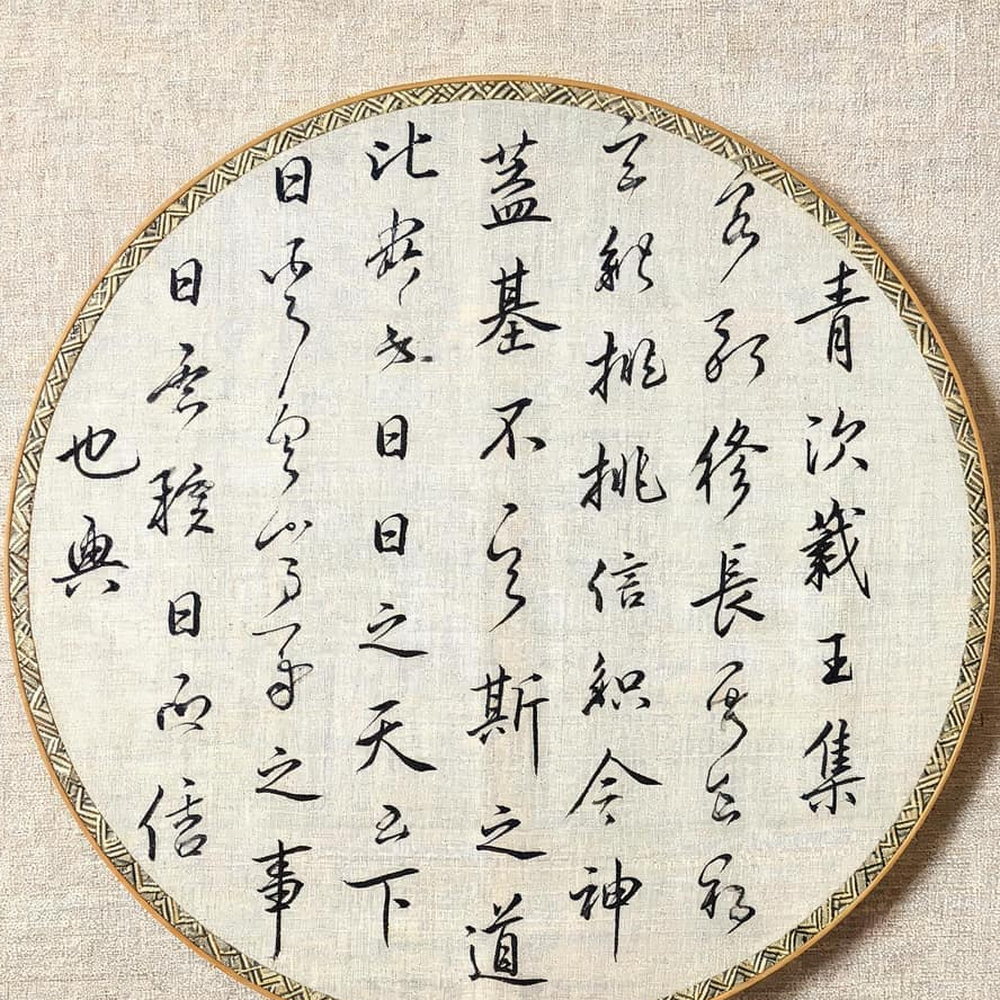
See the line and colour of a mural clearly without entering a cave
Case: See the line and colour of a mural clearly without entering a cave
Experience
Grind a little azurite and earth red, lay a layer of colour over a line drawing, and you learn what the labour was
Case: Grind a little azurite and earth red, lay a layer of colour over a line drawing, and you learn what the labour was
← Scroll sideways for more →
Links lead to third-party marketplaces. This site has no promotional relationship with them.
Travel proposals · Meet the custom in its real setting
← Scroll sideways for more →
Related customs
← Scroll sideways for more →
Fact-checked October 2026 · every citation traceable
Primary sources are Chinese-language publications, cited for traceability. Bodies without a standard English name are listed by domain.