FestivalsYunnan
Munao Zongge
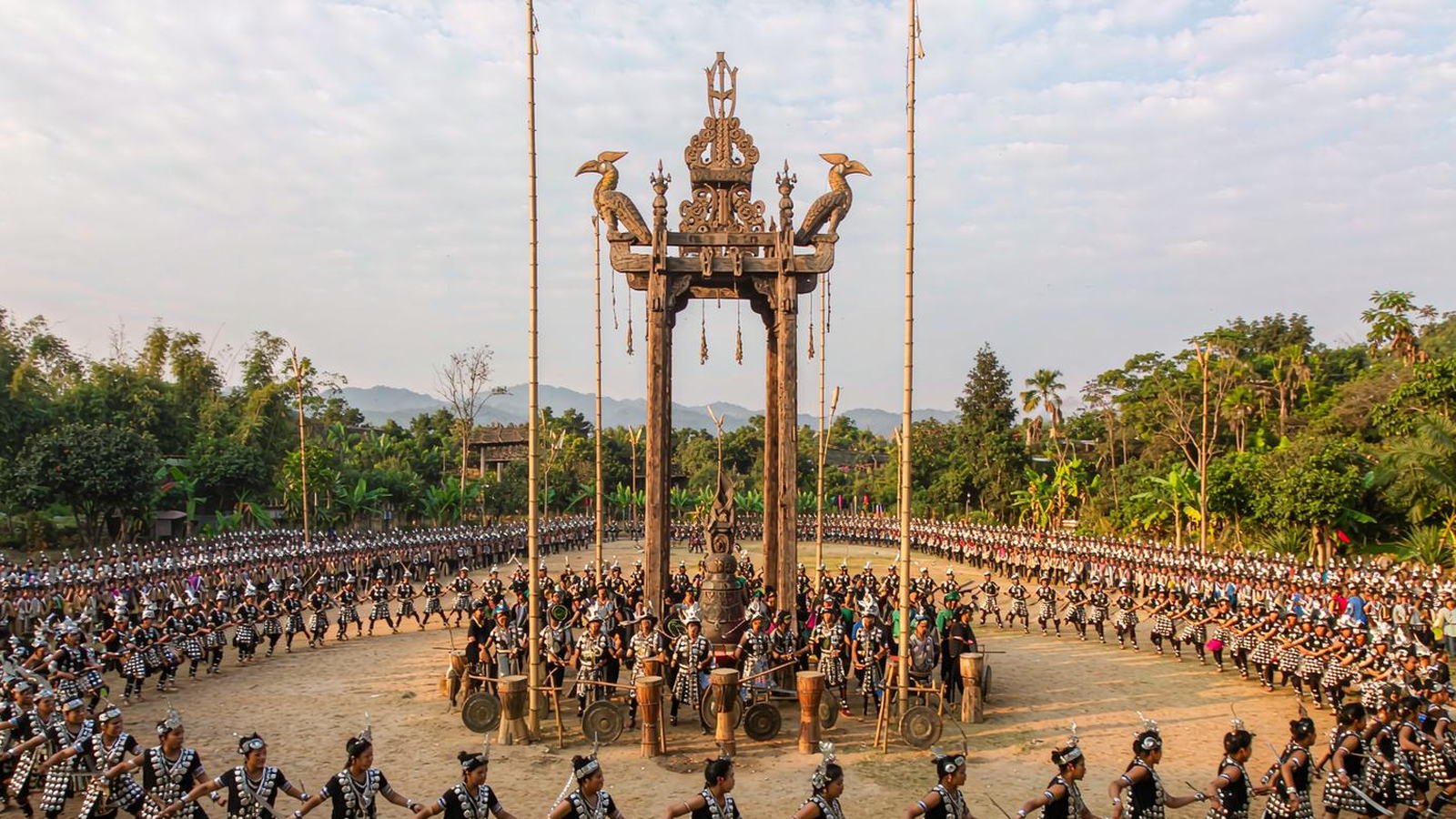
The greatest festival of the Jingpo year. Tens of thousands dance in a spiral around the totem pillars to a single drumbeat — the 'dance of ten thousand people'.
The greatest festival of the Jingpo year. Tens of thousands dance in a spiral around the totem pillars to a single drumbeat — the 'dance of ten thousand people'.
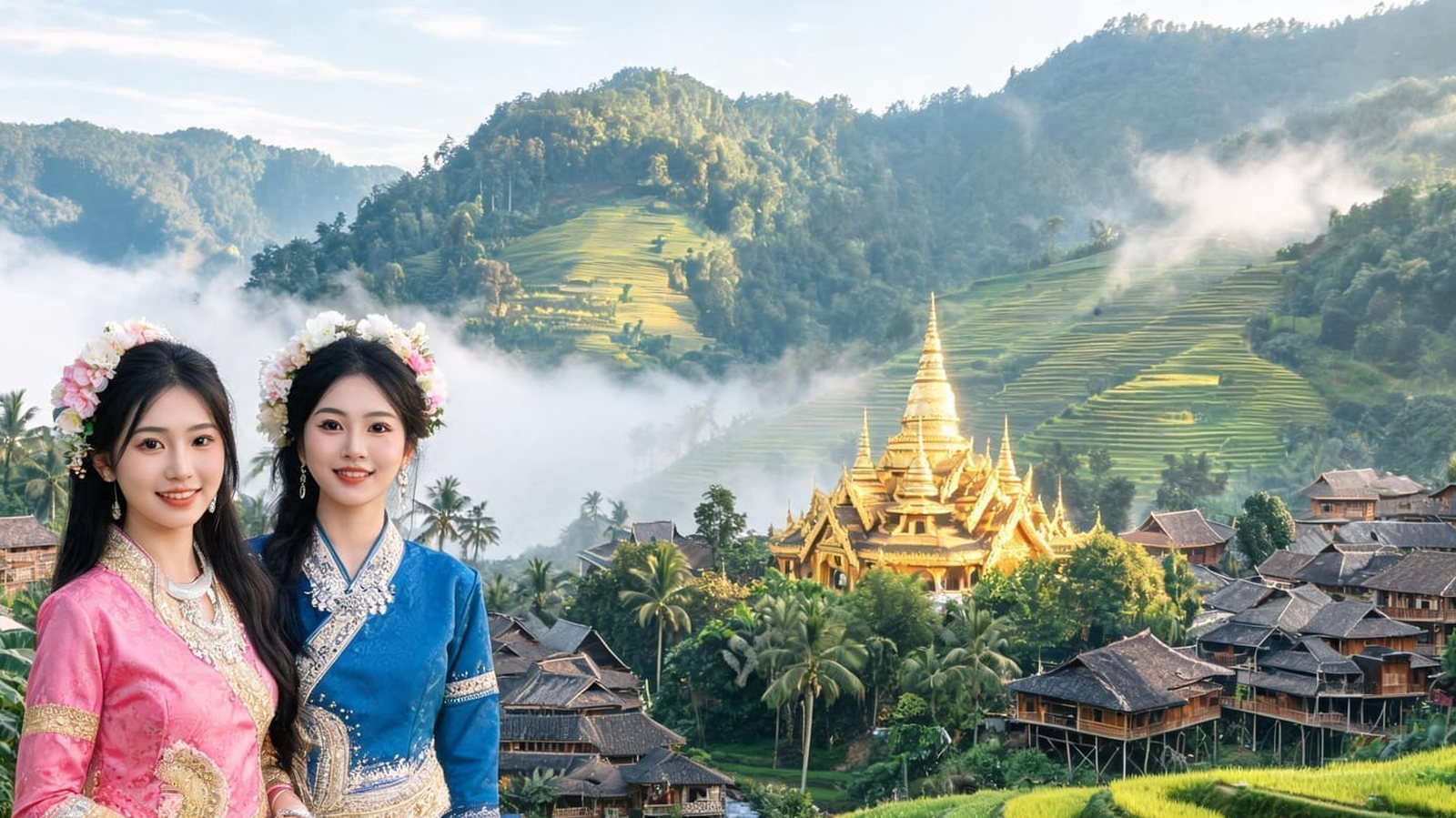
On the fifteenth of the first lunar month, four tall Manau Shidong pillars go up in the square in Dehong, hornbills and peacocks carved at their heads. The wooden drums sound, the gongs answer, and the naoshuang, wearing a hornbill headdress, leads the procession in. Tens of thousands step to one beat, winding slowly along the dance line. Silver-studded costumes flash in the sun; the dancing runs from morning to dusk, the line coiling around the pillars like a river moving across the land.
The steps follow the road the ancestors walked, and every step lands on the same beat.
Traditions, echoed by a new generation
Tens of thousands dance to one drum, and you need no steps and no choreography — just fall in and walk with the line as the circles widen, one inside the next.
No barrier to entry: keep to the beat and you can slip into a ten-thousand-strong dance line, social anxiety included
Silver-studded finery photographs like a film still — the 'dance of paradise' that floods short-video feeds every year
The green-leaf feast uses no bowls or chopsticks: ghost chicken and pounded salads spread on leaves, eaten by hand.
History · Customs · Cultural meaning
 Munao Zongge · Historical Origins
One continuous line · back to the source
'Munao' is a Jingpo word; 'zongge' is a literal rendering from the Zaiwa language; together they mean 'let us all dance', and Jingpo speakers also call it 'Zongge'. The Jingpo creation epic holds that the dance began in the palace of the sun and was carried to earth by birds, and that humans learned it and passed it down generation after generation. The course of the steps traces the very route by which the Jingpo ancestors moved south from the north into Dehong, Yunnan — one dance is one retelling of the road a people walked.
In the past, Munao Zongge was divided by occasion into more than a dozen forms: Su Manau for a good harvest and wealth, Badang Manau for victory, Dingshuan Manau for a new house, Jieru Manau for the departure of troops. In 1983 it was made a statutory festival of the Dehong Dai and Jingpo Autonomous Prefecture, fixed on the fifteenth and sixteenth of the first lunar month. In 2006 the Jingpo Munao Zongge, nominated by Longchuan County, was entered on the first national list of intangible cultural heritage (Ⅹ-11).
Munao Zongge · Customs and Practice
Seasonal rites · everyday life
At the centre of the dance ground stand the Manau Shidong — four tall wooden pillars, raised to honour the sun and to mark the dance route. Knives and spears are set at their sides, hornbills and peacocks carved at both ends of the crossbeams, a living bamboo pole planted in front to mean life evergreen, and a horizontal plaque above painted with the Himalaya, the place of origin in legend. The lead dancer is the naoshuang, hornbill-crowned, carrying a long sword to open the way.
Once the dance opens, wooden drums and gongs beat out the measure and tens of thousands fall into a long line, spiralling after the naoshuang along the route. There are few movements — a checked step, a roll of the shoulder — but the rhythm is unmistakable: however many dancers, the feet land as though one person were dancing. People come from a hundred li around, a thousand at the least and ten thousand at the most. The festival also sets out the green-leaf feast: no bowls or chopsticks, banana leaves for plates, pounded salads, ghost chicken and roast meat eaten by hand. The epic Manau Jaiwa is sung during the festival too.
Munao Zongge · Cultural Significance
What the heart turns toward · handed down through generations
The Jingpo live scattered across high mountains and long roads, and Munao Zongge is the one occasion in the year when whole villages and the whole people gather. The dance line gathers thousands into a single procession; at the first drumbeat, no one is left behind. The creation legend, the migration road and the reason for celebration are all packed into the steps and the singing, brought out by the leading naoshuang and passed on to the young people following behind.
Today the festival is Dehong Prefecture's annual cultural centrepiece, with grounds in Mangshi, Longchuan, Ruili and Yingjiang. Local schools have folded the steps into morning exercises, a Munao Zongge cultural park has been built, and naoshuang and folk artists take on apprentices in batches. Longchuan County, where the transmission is intact, is known as the home of Munao Zongge.
To admire and to use · Tradition in everyday life
Experience
Head for Longchuan around the fifteenth of the first lunar month and step to the same drum as ten thousand dancers.
Case: Head for Longchuan around the fifteenth of the first lunar month and step to the same drum as ten thousand dancers.
Food
Pounded salads, ghost chicken and roast meat served on banana leaves — the mountain flavours of the Jingpo.
Case: Pounded salads, ghost chicken and roast meat served on banana leaves — the mountain flavours of the Jingpo.
Craft
Modelled on the silver bosses along the lapel of Jingpo festive dress, chiming softly as you walk.
Case: Modelled on the silver bosses along the lapel of Jingpo festive dress, chiming softly as you walk.
← Scroll sideways for more →
Links lead to third-party marketplaces. This site has no promotional relationship with them.
Travel proposals · Meet the custom in its real setting
← Scroll sideways for more →
Related customs
← Scroll sideways for more →
Fact-checked October 2026 · every citation traceable
Primary sources are Chinese-language publications, cited for traceability. Bodies without a standard English name are listed by domain.